
Part 5 · People and team
NFC tags
Stick an NFC tag on a door, a laptop or a file, and bring a phone close to take a room, lend equipment, record attendance or do a patrol.
A tag is a small NFC chip stuck on a door, a laptop, a file or a machine. Bring a phone close, and Symbifox performs the gesture attached to it: open a record, log a visit, take a room, lend a laptop, record attendance, tap a patrol checkpoint, report a problem. The application serves the person who prepares the tags and the whole team that taps them. The result: a field gesture that leaves a dated, signed record, without opening a computer.
Overview#
A tag carries only a short public code, never a password. It can be read from four centimetres and copied for a few cents: what you engrave is a poster, not a secret. Identity comes from elsewhere, and that is what separates the three ways to tap a tag.
| Door | Where identity comes from | For whom |
|---|---|---|
| The Symbifox Pastilles app | the phone, paired once with the person's account | the team, on Android |
| The browser | the Symbifox session already open | anyone with an account, on any phone |
| The signed tag | an NTAG 424 DNA chip that signs every read | a tag handed to someone without an account |
Each tag is attached to a gesture. The gesture says what happens, and it always runs with the rights of the person tapping: a record they may not see stays closed.
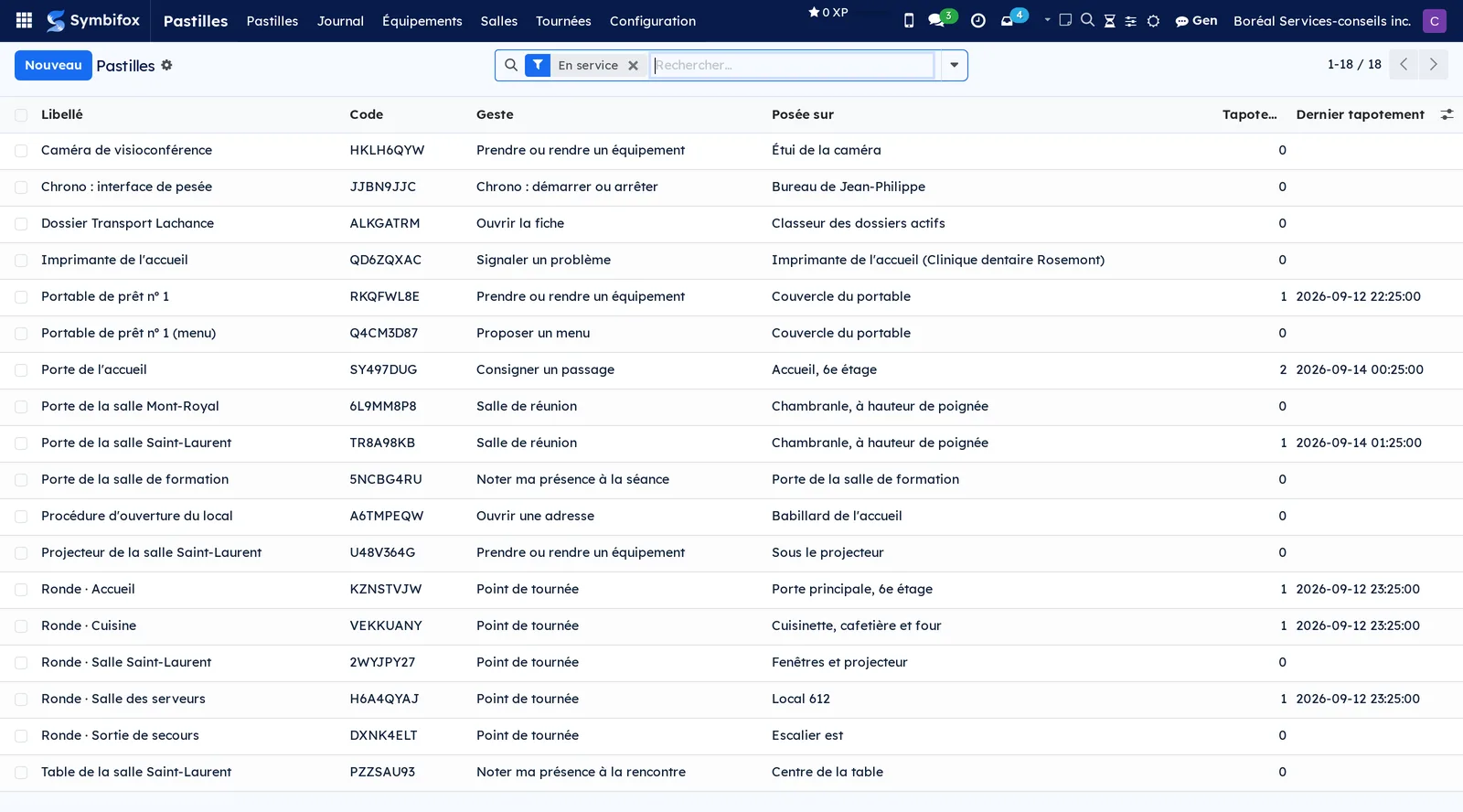
The Tags screen lists the organization's tags, with their gesture, where they are placed, the number of taps and the last one.
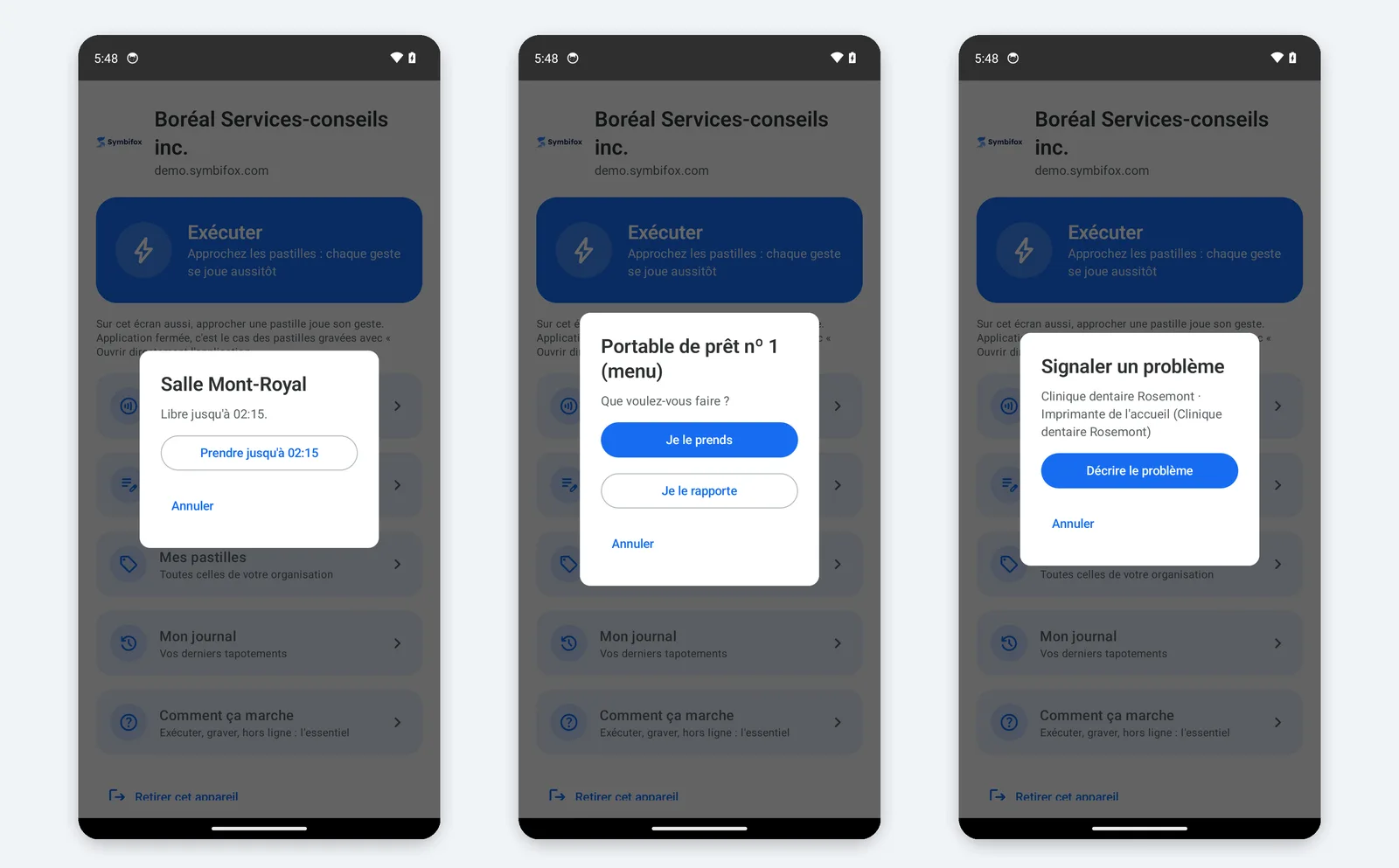
Three behaviours set Symbifox's approach apart. First, nothing acts when a link is merely opened: link previews, spam filters and security scanners open addresses nobody touched, so a gesture that changes data goes through a confirmation in the browser. Second, a tag may ask a question instead of acting: a few buttons, sometimes a sentence to write, and nothing is done until you choose. Third, a tap without a network is not lost: the phone keeps it with its time and sends it when the network is back.
Here are three questions as the app asks them: a free room, a menu on a laptop, a problem to report.
Tags touch several applications: the timer in Timer, the Calendar for rooms, Helpdesk for tickets, Meetings and training for attendance.
Configuration#
Access and rights#
Two groups are offered in Settings › Users, category NFC tags:
| Group | What it opens |
|---|---|
| Use | Tap tags and read one's own taps. Every employee is a member. |
| Management | Create tags, choose gestures, read the whole log, remove a device, play gestures reserved for managers |
The Configuration menu only shows to members of the Management group. The gestures "Run a scheduled action" and "Run an action" are reserved for managers, even when offered in a menu.
Settings#
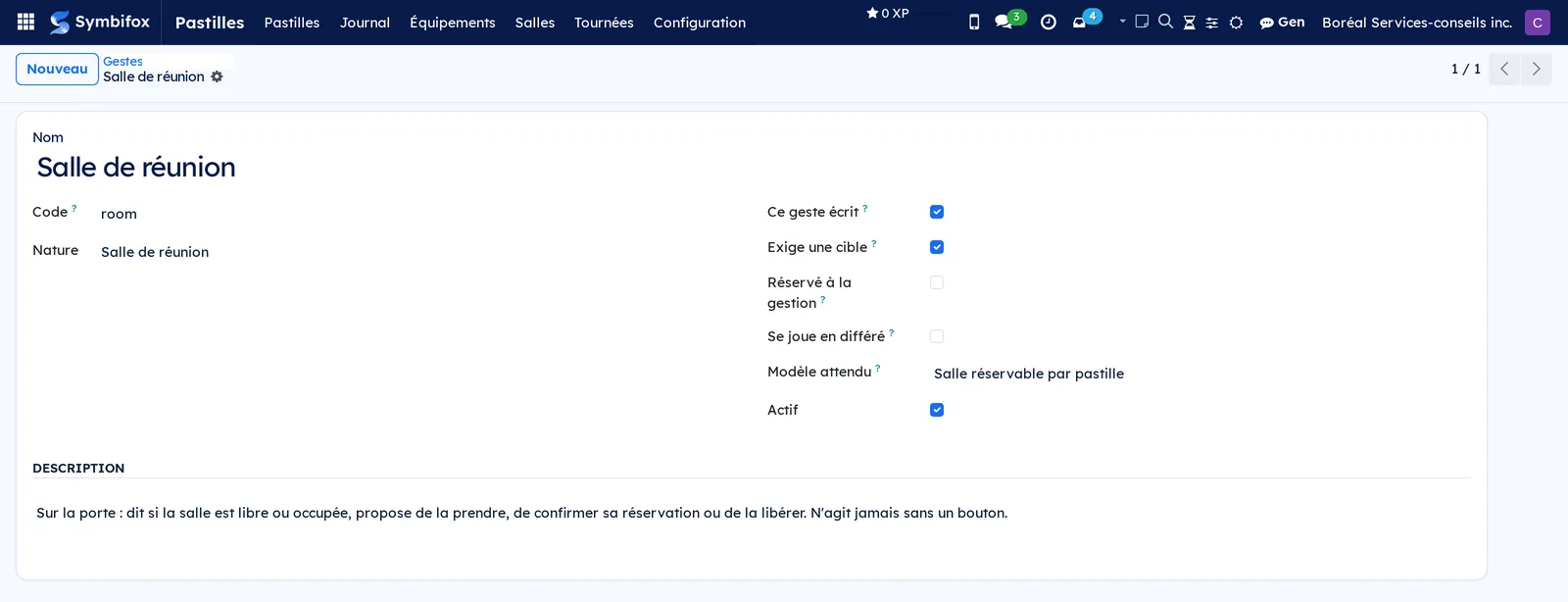
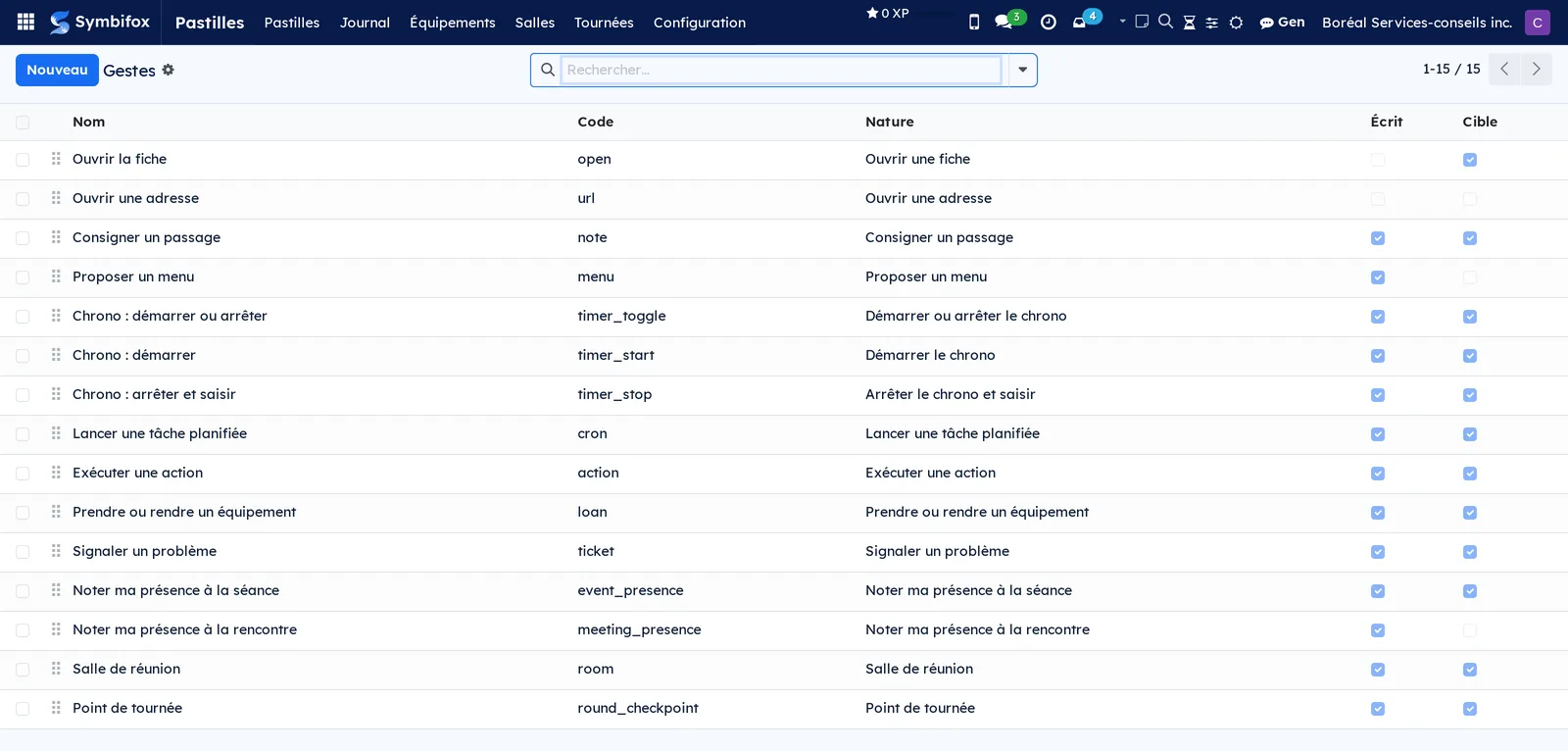
Gestures are set in Tags › Configuration › Gestures. For each one, three checkboxes decide its behaviour:
- This gesture writes: a gesture that changes data asks for confirmation when it comes through the browser.
- Reserved for managers: only a manager can play it.
- Can be sent later: a tap made without a network and sent later is accepted, with the time recorded by the phone. Leave it unchecked for what only makes sense on site and right away, such as opening a record, starting a timer or taking a room.
Master data#
Depending on the gestures you use, first prepare what the tags will point to:
- the equipment to lend, in Tags › Equipment;
- the rooms, in Tags › Rooms;
- the rounds and their checkpoints, in Tags › Rounds;
- training sessions and their venue, in the Events application;
- the customer records that will receive tickets.
You also need blank NFC chips. NTAG213 stickers suit most uses; NTAG 424 DNA chips are for signed tags.
Getting started#
This walkthrough engraves a tag that logs a visit at the reception door, then taps it.
- Install the Symbifox Pastilles app on an Android phone, from the Symbifox F-Droid repository.
- Open the app and select your account, or enter your instance's address, then sign in on the page that opens.
- Select Graver une puce (engrave a chip), then Pastille (tag).
- Select the gesture Log a visit, then search for the record "Boréal Services-conseils inc.".
- Enter the label "Reception door" and the place "Reception, 6th floor", then select Graver (engrave).
- Bring a blank chip close to the back of the phone and hold it still until the message "Gravée et vérifiée" (engraved and verified).
- Go back to the app's home screen and bring the tag close: the note "Visit recorded by tag" appears in the record's discussion thread.
The tag also appears in Tags › Tags, and the tap in Tags › Log.
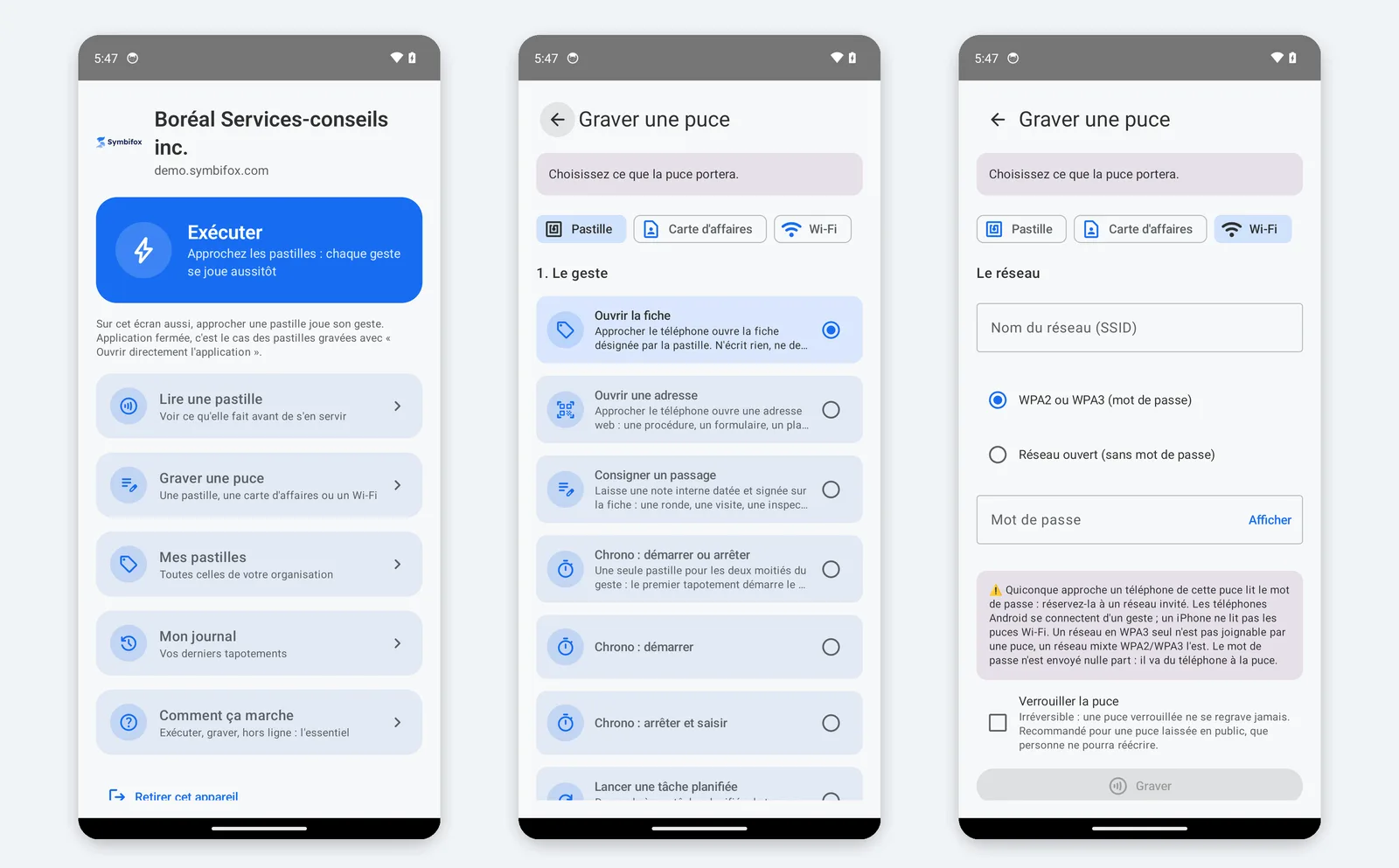
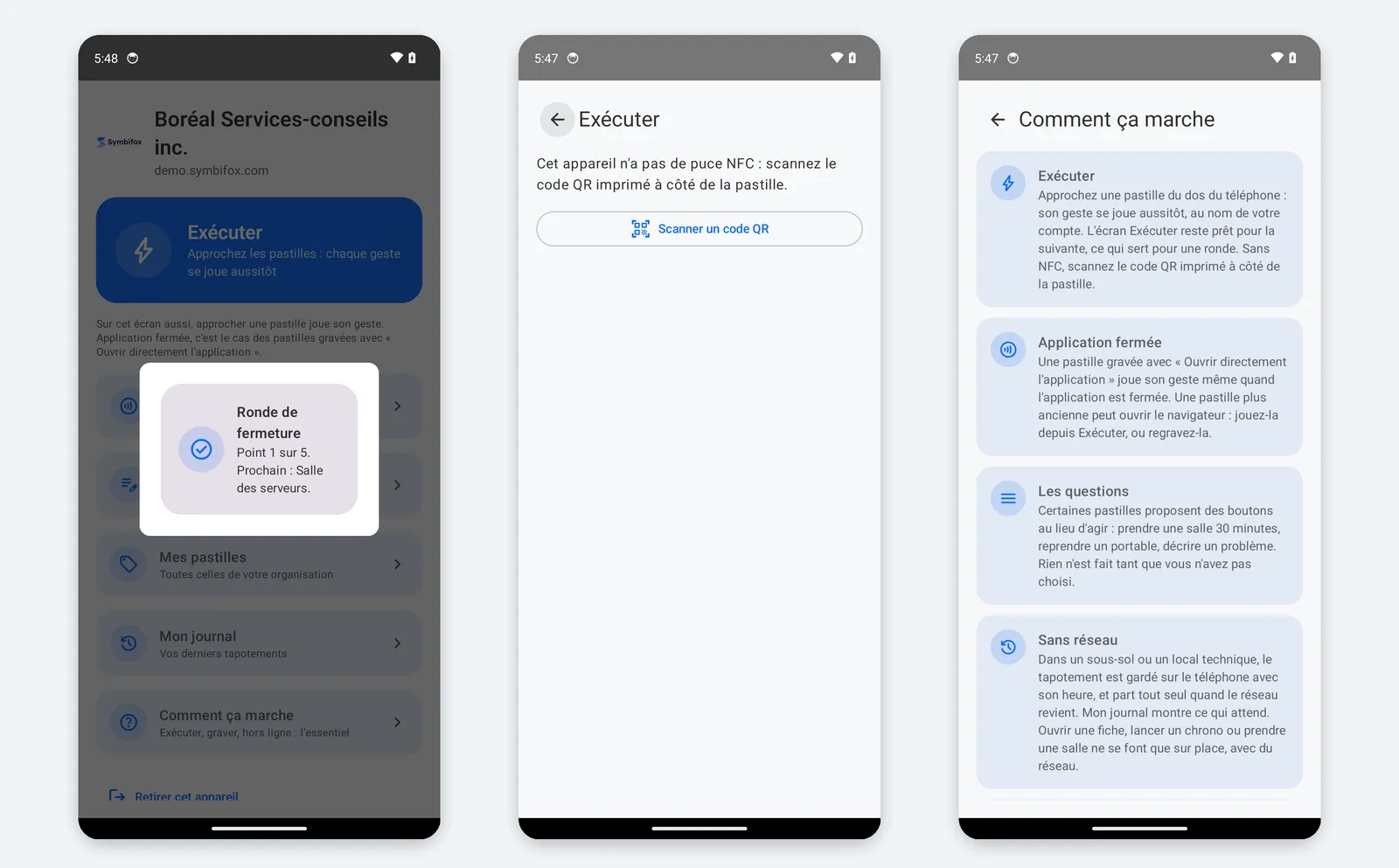
Once paired, the app's home screen leads to these screens.
Common tasks#
Engrave a tag#
Engraving creates the tag's record, then writes its address on the chip and reads it back to check.
- In the app, select Graver une puce, then Pastille.
- Choose a gesture. Depending on the gesture, the screen asks for a record, a web address or a text.
- Enter a label and the place where the tag will be stuck.
- Leave Ouvrir directement l'application (open the app directly) checked, so the tag plays its gesture even when the app is closed.
- Check Verrouiller la puce (lock the chip) only for a tag placed for good: the lock cannot be undone.
- Select Graver, then bring the chip close.
The message "Gravée et vérifiée" confirms that the chip reads back what was just written.
Tap a series of tags#
The Exécuter screen keeps listening: each tag brought close plays its gesture right away, and the screen keeps the list of the series. It is the screen for a patrol or an inventory round.
- In the app, select Exécuter.
- Bring the tags close one after another.
- Answer the questions when a tag asks one.
On a phone without NFC, select Scanner un code QR (scan a QR code) and aim at the label printed next to the tag.
Prepare a menu on a tag#
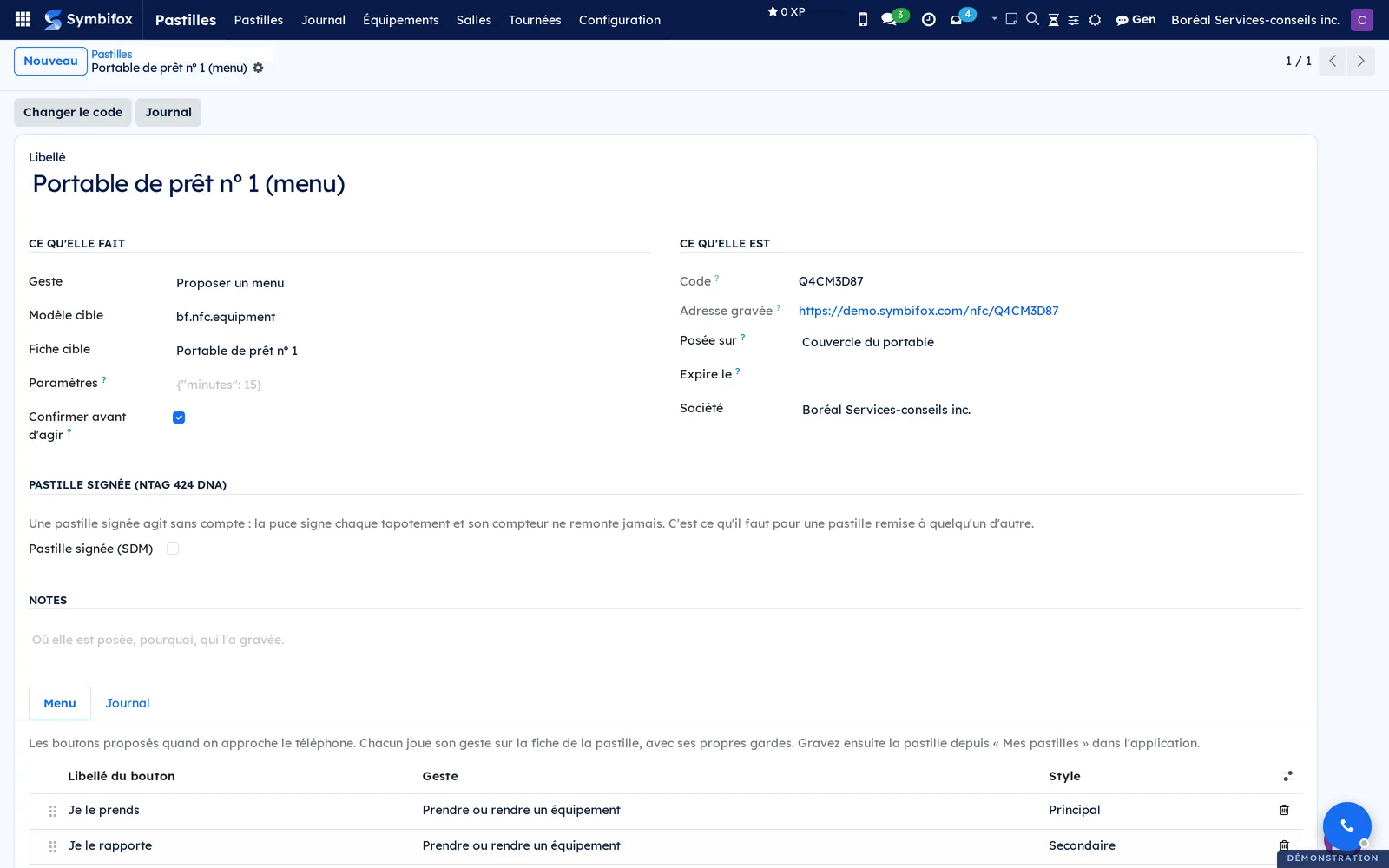
A menu offers a few buttons instead of a single gesture: "I'm taking it" and "I'm bringing it back" on a laptop, for example.
- Go to Tags › Tags and select New.
- Choose the gesture Offer a menu and the target record.
- In the Menu tab, add one line per button: its label, its gesture and its style.
- Save.
- In the app, open Mes pastilles (my tags), touch the tag, then engrave it on a chip.
All buttons act on the tag's record, and each keeps its gesture's safeguards.
Lend equipment#
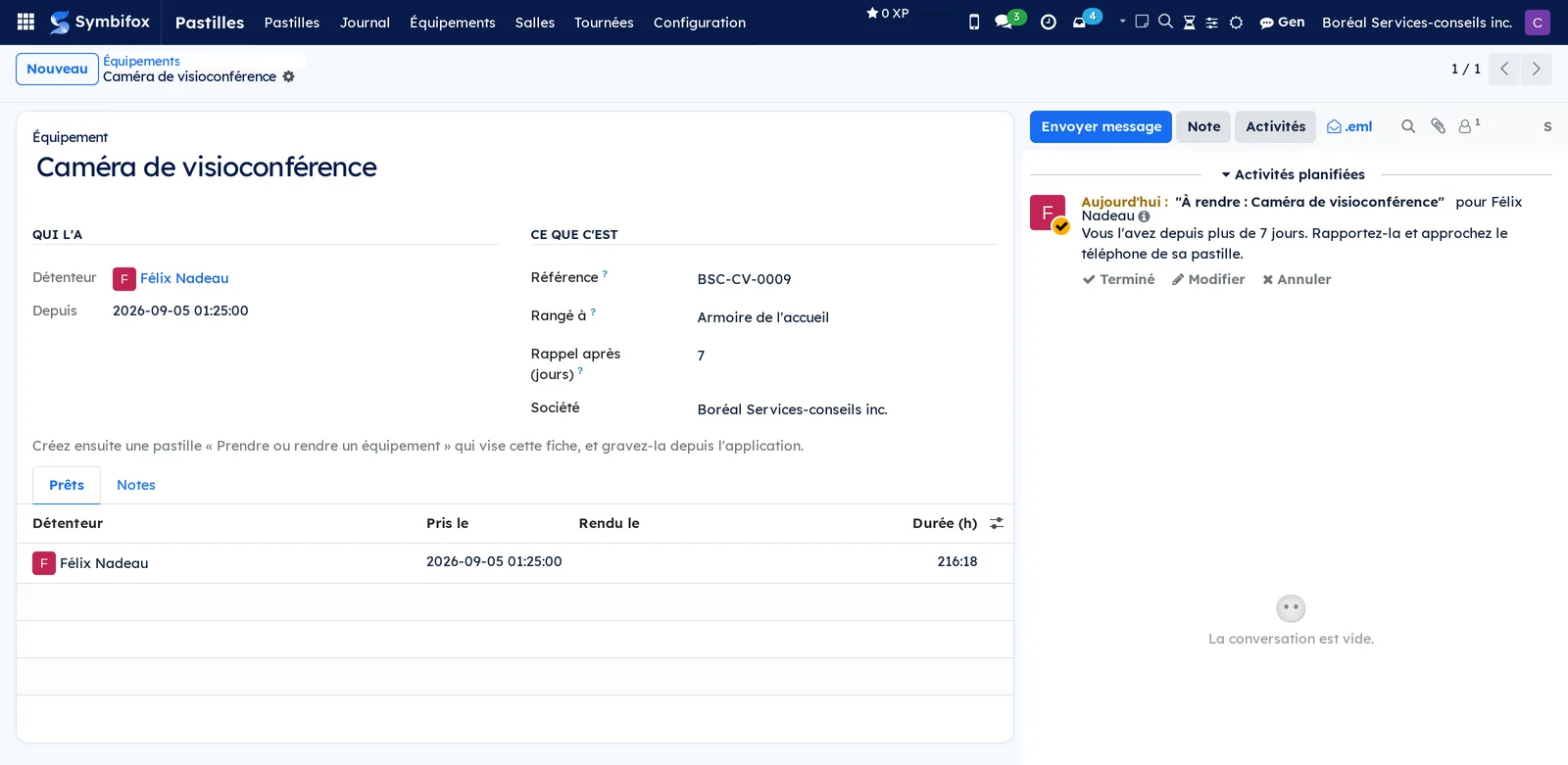
A "Take or return equipment" tag keeps the loan register with no button in the two usual cases.
- Go to Tags › Equipment and create the equipment, with the place where it is stored and the reminder delay.
- Create a tag with the gesture Take or return equipment pointing to that equipment, then engrave it.
- Bring the phone close: free, the equipment is yours; yours, it is returned.
If someone else has it, the screen names them and offers I'll take it anyway. Beyond the reminder delay, the person keeping it gets a "To return" activity.
Take a meeting room#
The door tag first says whether the room is free or taken, then offers to act. The first tap never takes anything.
- Bring the phone close to the door.
- Free, select Take 30 min or Take 1 h: the booking is created in the calendar, already confirmed.
- Booked by you and about to start, select I'm here.
- When leaving, bring the phone close again and select Release the room.
A booking nobody confirms within the room's delay loses its room: the event stays in the calendar, and a note says so.
Record attendance at a session or a meeting#
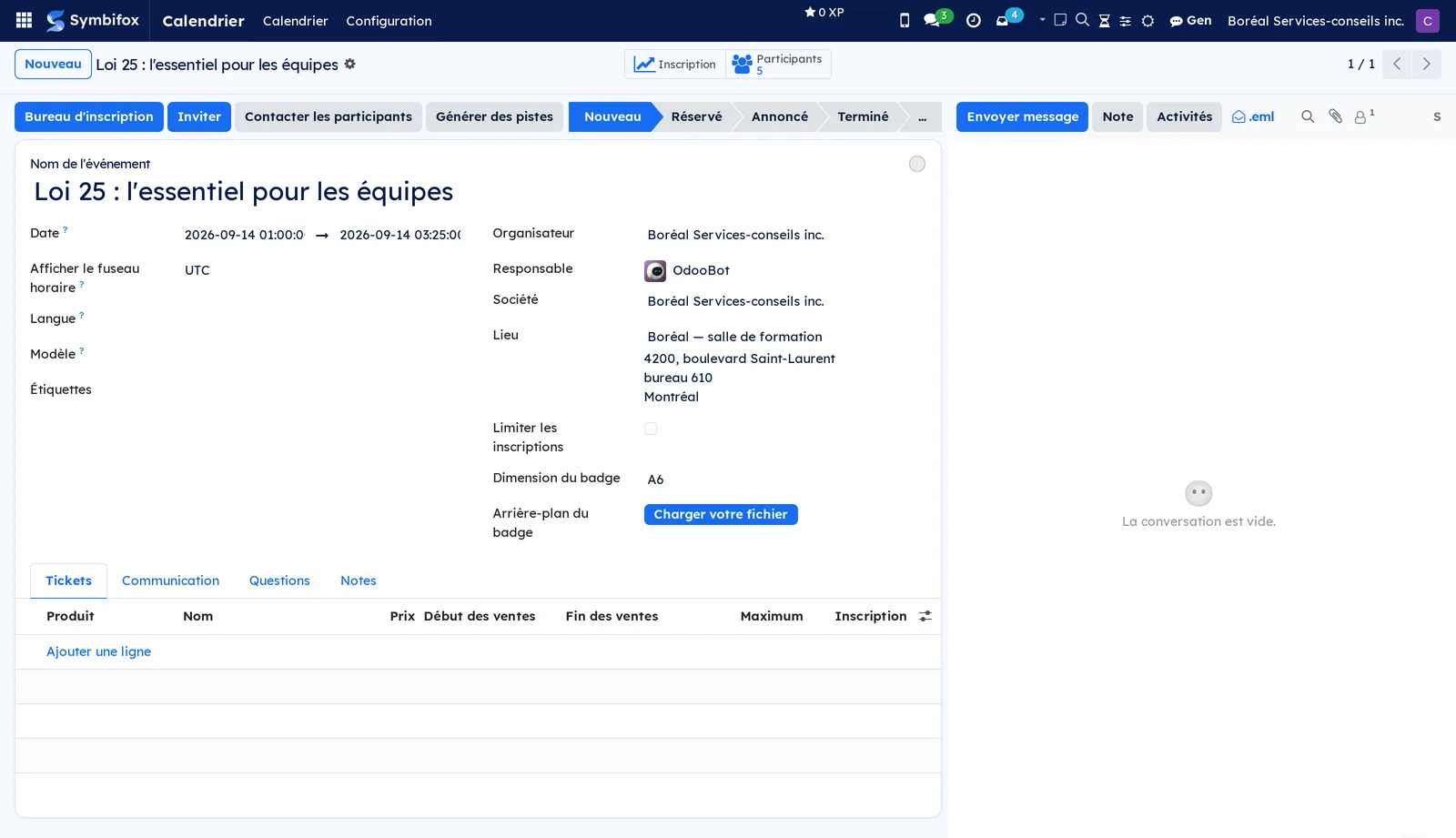
On the training room door, the tag records the person's attendance at the session in progress at that venue. On the meeting room table, it records attendance at the meeting in progress the person is invited to.
- Bring the phone close to the tag when arriving.
- If two sessions or two meetings are running at the same time, choose yours.
The registration becomes "Attended". Without a registration, one is created: this records who came, not only who had registered.
Do a round#
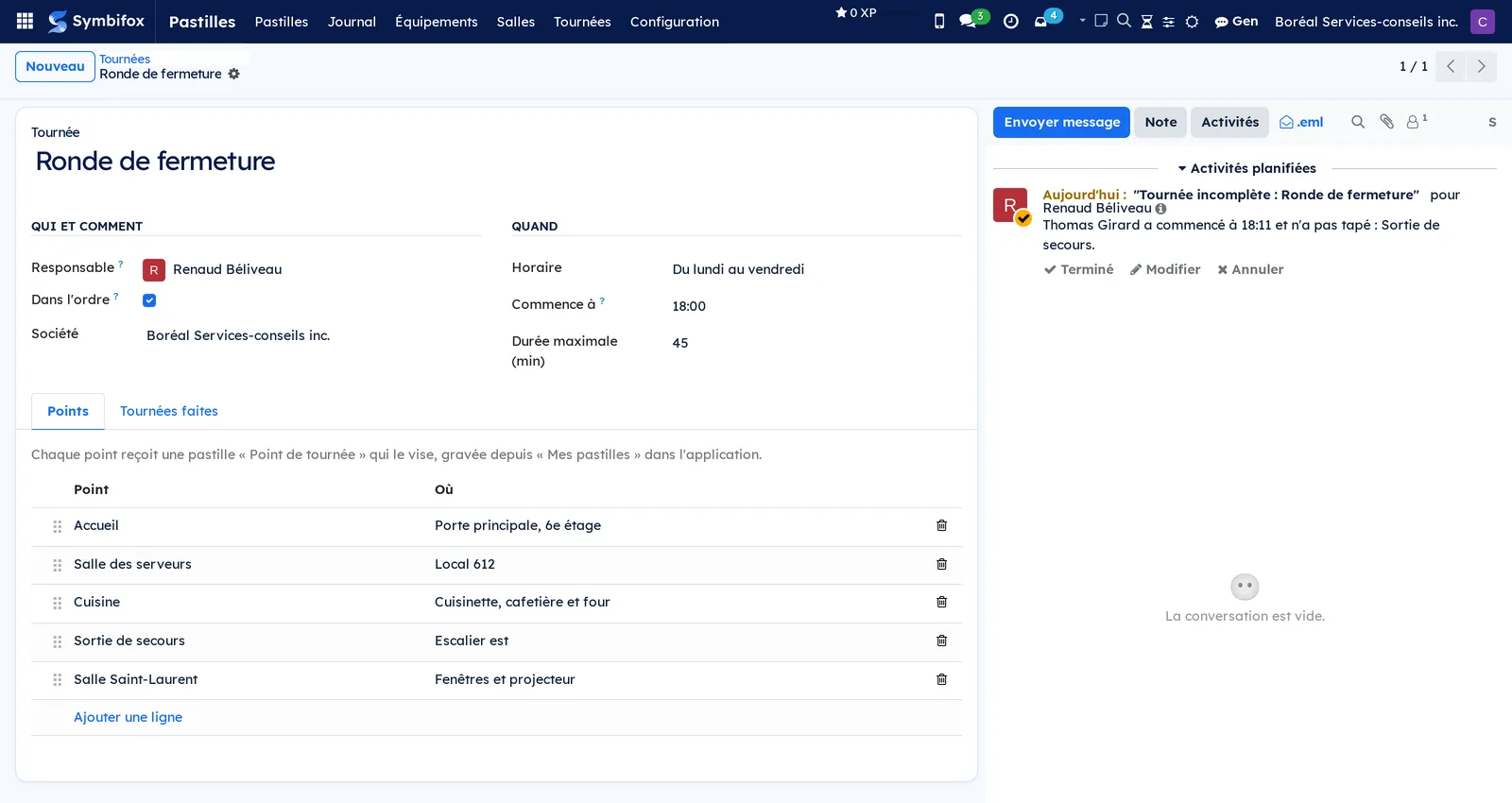
- Go to Tags › Rounds and create the round: person in charge, checkpoints in order, schedule and maximum duration.
- Create a Round checkpoint tag for each checkpoint, then engrave them from Mes pastilles.
- During the patrol, tap the checkpoints: the phone says "Checkpoint 3 of 5. Next: Kitchen."
At the last checkpoint, the round closes. A round started and not finished within its duration, or a scheduled round nobody did, creates an activity for the person in charge.
Report a problem#
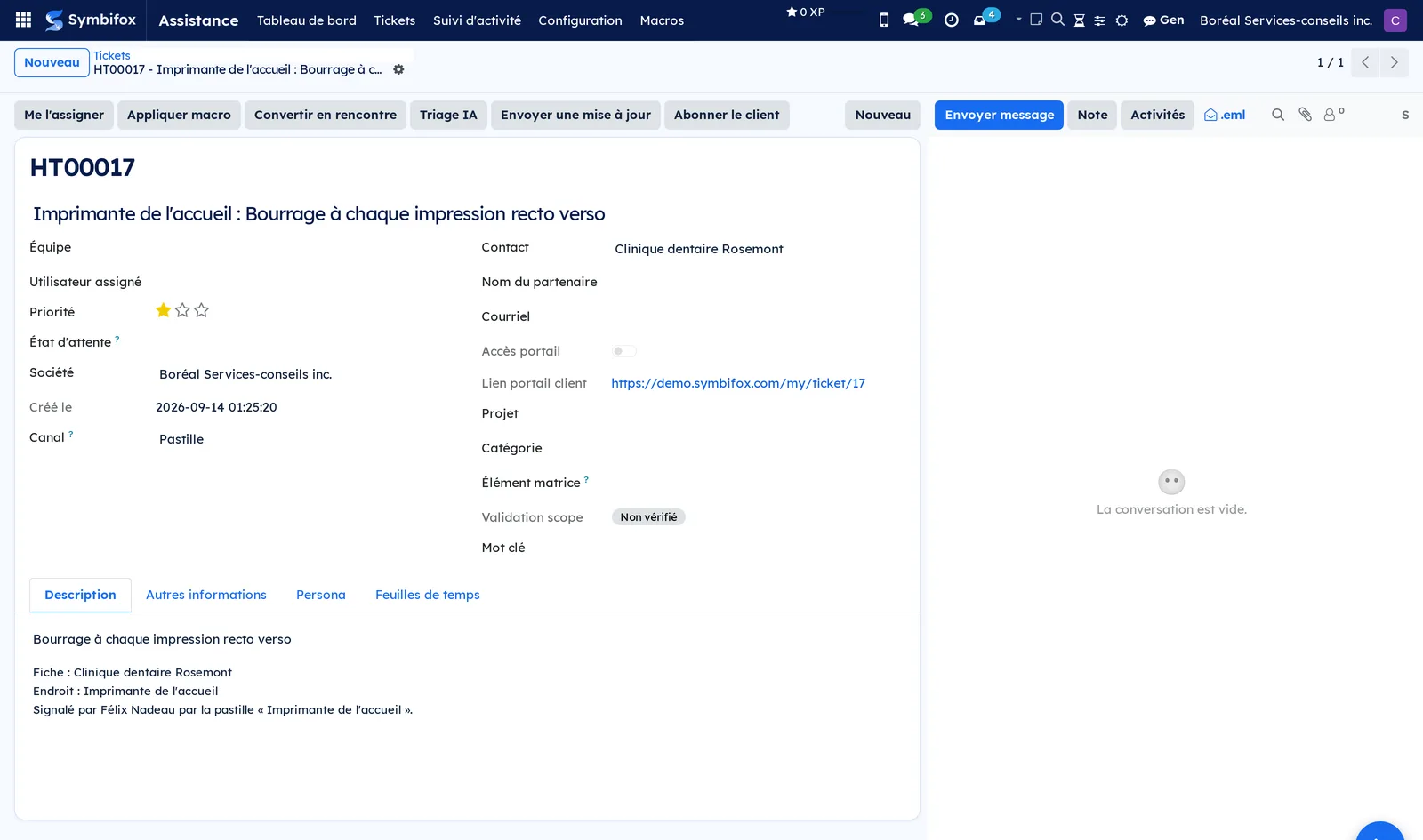
A tag on a customer's printer or machine opens a ticket already filled in.
- Bring the phone close to the tag.
- Select Describe the problem, write one sentence, then select Envoyer (send).
The ticket is created in Helpdesk, in the "Tag" channel, with the customer, the place, who reported it and when. The person who reported it follows the ticket and receives its updates.
Print labels#
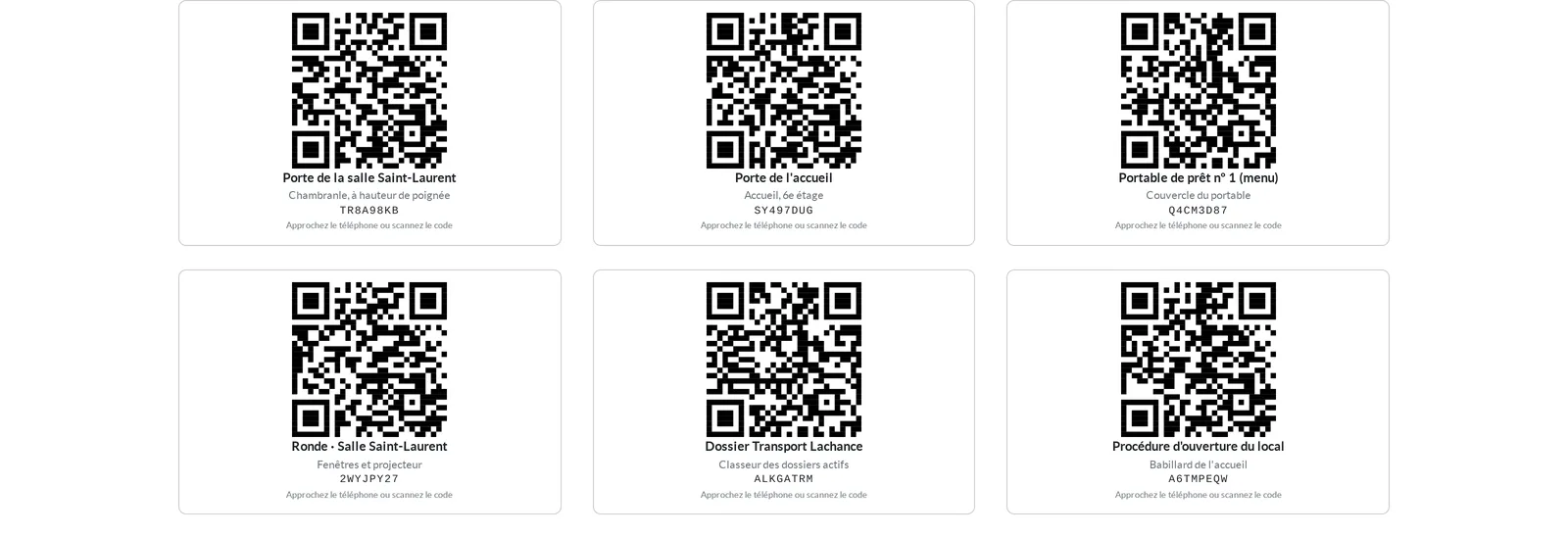
Every tag prints as a label with its QR code twin, for phones without NFC.
- Go to Tags › Tags.
- Check the tags you want.
- Select Print › Label with QR code.
A signed tag prints without a QR code: its address changes at every read.
Engrave a business card or a guest Wi-Fi#
These two chips are not tags: they carry the information itself and can be read without an app or an account.
- In the app, select Graver une puce.
- Choose Carte d'affaires (business card) and your link page, or Wi-Fi with the network name and its password.
- Check Verrouiller la puce for a chip left in public, then select Graver.
Remove a lost phone#
- Go to Tags › Configuration › Devices.
- Select the phone, then delete it.
Its token is erased: the phone can no longer play anything, even if it is found.
The menus, one by one#
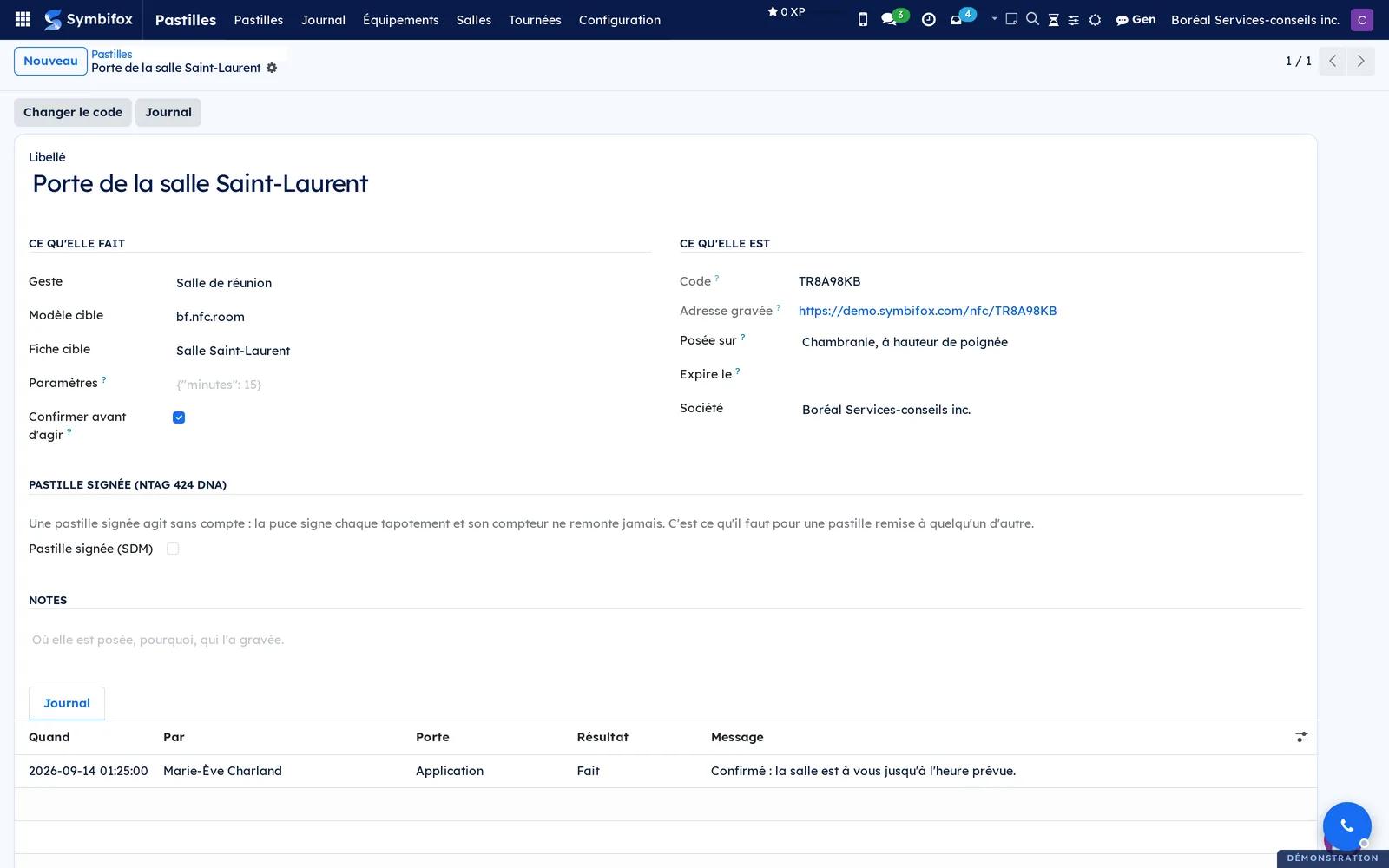
Tags › Tags: the organization's tags, with their gesture, place, number of taps and last tap. The In service, Signed and Never tapped filters help find a tag to remove. The form holds the gesture, the target record, the parameters, the Menu tab for a menu tag, the signed tag section and the tag's log.
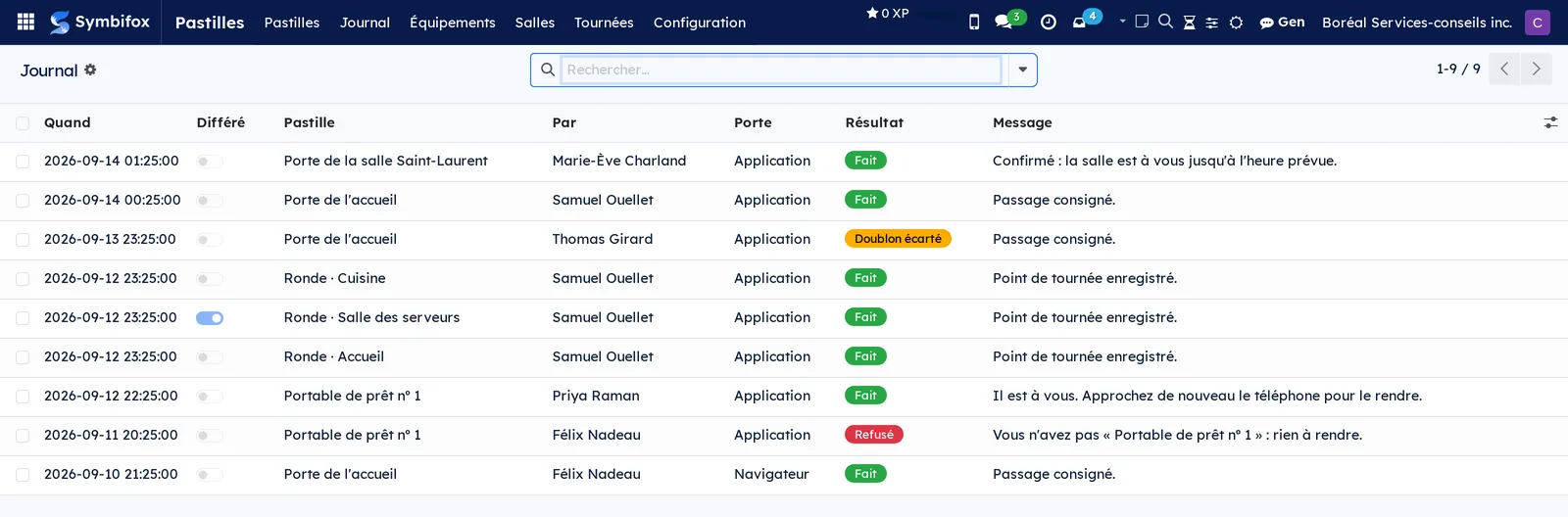
Tags › Log: every tap, including those that did nothing. Columns: when, tag, person, door, result and message. The Sent later filter shows taps made without a network. Each person sees their own; managers see everything.
Tags › Equipment: the lendable equipment, with its holder and since when. The On loan, Free and Mine filters answer everyday questions.

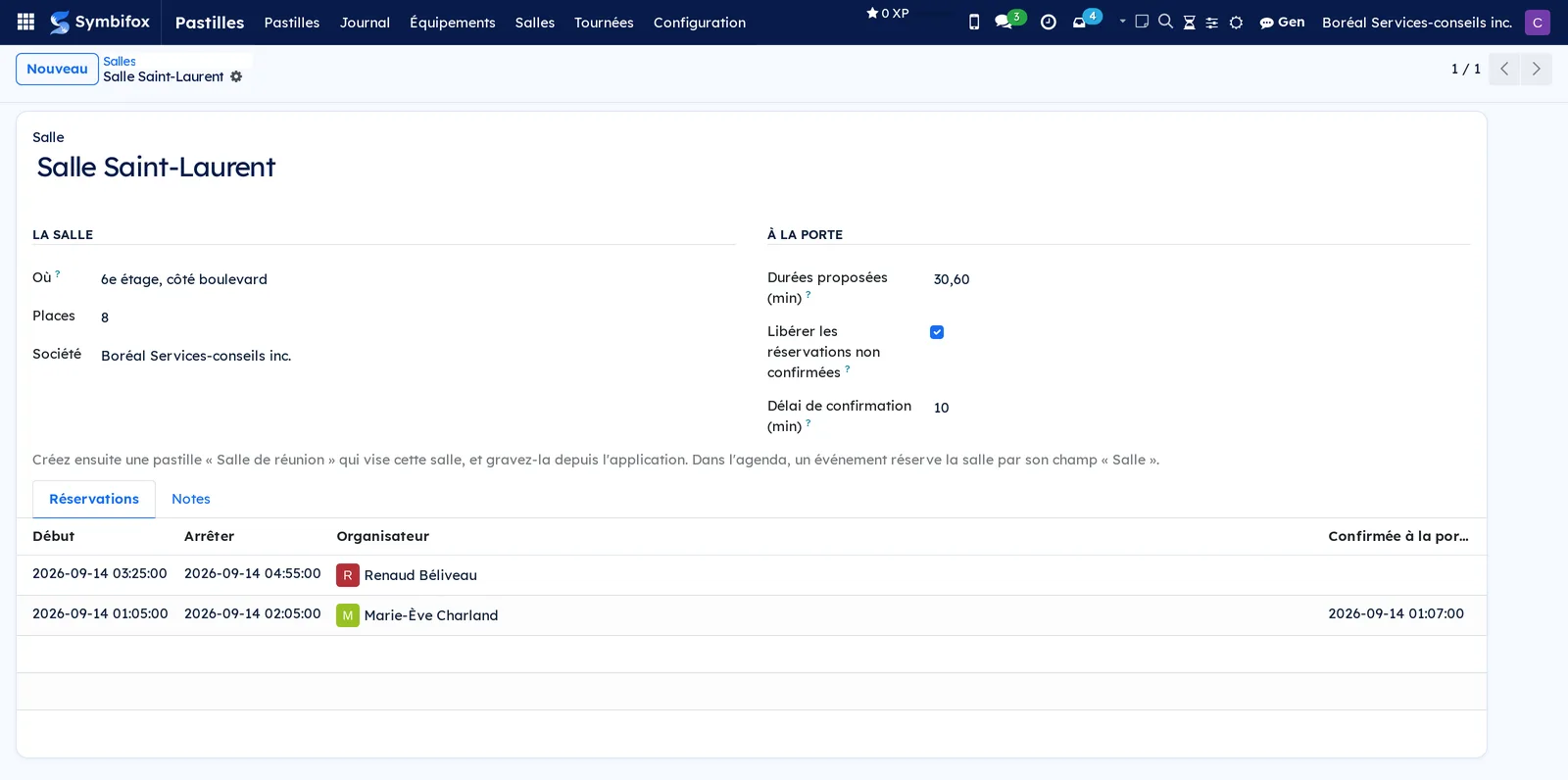
Tags › Rooms: the rooms bookable at the door, with their capacity and release rule. The form lists the room's bookings.
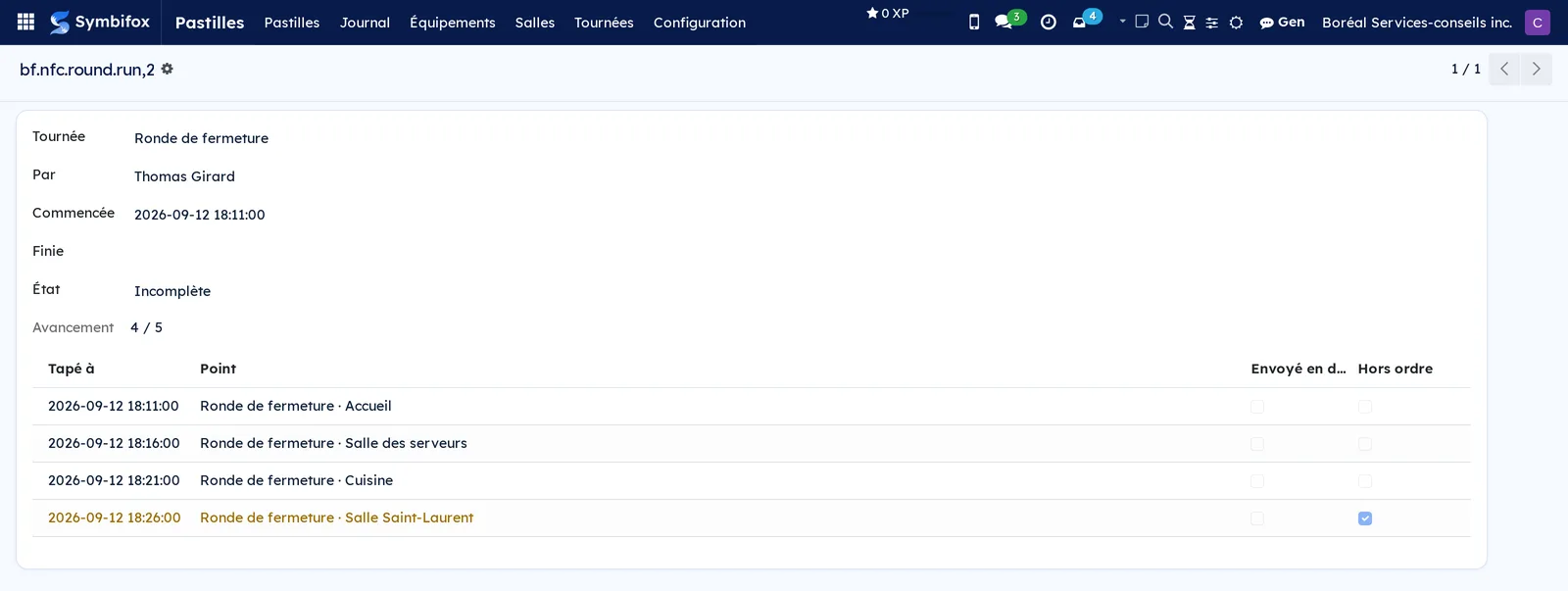
Tags › Rounds: the rounds, their person in charge, schedule and number of checkpoints. The form holds the checkpoints in order and the completed rounds, marked complete or incomplete.
Tags › Configuration: grouping menu, visible to managers.
Tags › Configuration › Gestures: the gesture catalogue, with their kind and settings.
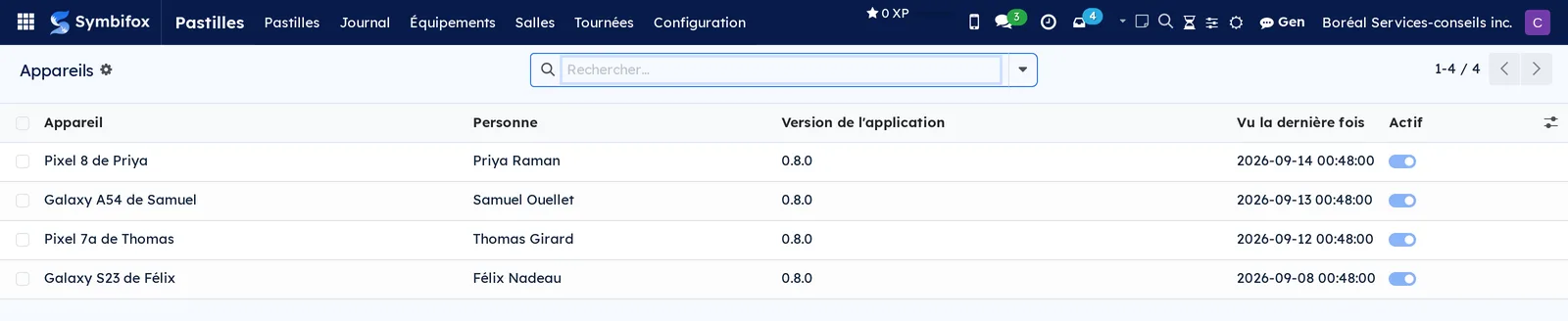
Tags › Configuration › Devices: the paired phones, their person and when each was last used.
Reference#
Tag form fields#
| Field | Description | Required or default |
|---|---|---|
| Label | The tag's name, the one read on the phone's screen | Required |
| Gesture | What the tag does | Required |
| Target model and Target record | The record the gesture points to | Depends on the gesture |
| Parameters | Settings specific to the tag, for example a visit's text | Optional |
| Confirm before acting | Confirmation page for a gesture that writes, through the browser | Checked |
| Code | What the chip carries, drawn at random | Automatic |
| Placed on | Where the tag is stuck | Optional |
| Expires on | After this date, the tag politely refuses | Optional |
| Signed tag | Turns on the chip signature check | Unchecked |
| Acts on behalf of | The account a signed tag acts for | Required for a signed tag |
Room form fields#
| Field | Description | Required or default |
|---|---|---|
| Room | The name shown at the door | Required |
| Where and Seats | Floor and capacity | Optional |
| Offered durations (min) | The "Take" buttons, separated by commas | 30,60 |
| Release unconfirmed bookings | Frees the room when nobody confirms | Checked |
| Confirmation delay (min) | The time allowed to confirm after the start | 10 |
Reports and exports#
The Label with QR code prints from the tag list or form. The log, loans and completed rounds export like any list.
Automations#
- Every day, equipment kept beyond its reminder delay creates a "To return" activity for its holder, once per loan.
- Every five minutes, room bookings not confirmed within their delay lose their room.
- Every quarter of an hour, incomplete or missed rounds create an activity for the person in charge, once per miss.
- Every day, phone pairings started and never finished are removed.
Public pages and portal#
A tag tapped by a phone without the app opens a Symbifox page. With a session open, a gesture that writes shows a one-button Confirmer (confirm) page, and a menu shows its buttons. A signed tag acts without an account, for the account it designates, after checking the chip's signature.
Modules that extend this application#
Understanding#
Why does a tag carry no secret? Because it can be read without consent and copied easily. All a tag allows is finding its record. What proves who taps is the paired phone, the open session or the chip's signature.
Why does a second tap in quick succession do nothing? Android sometimes reads the same chip twice, and fingers hesitate. Within twenty seconds, the same gesture by the same person on the same tag returns the first result instead of doing it again.
Why does a gesture that asks a question do nothing? Anything the gesture would have touched before asking is undone. The choice is what acts, in a second send.
What happens to a tap made without a network? The phone keeps it with the time of the tap and sends it when the network is back. Symbifox accepts that time if it is less than 72 hours old and not in the future. The same send repeated counts once.
Why doesn't a signed tag record attendance or a loan? It acts for a designated account, not for the person holding the phone. Recording attendance or a loan under that name would write false information in the register.
Why is a room taken at the door already confirmed? The person is standing at the door: confirming would be one gesture too many. Only bookings made in the calendar wait for confirmation.
Troubleshooting#
| Symptom | Probable cause | Fix |
|---|---|---|
| The tag opens in the browser instead of the app | The tag was engraved without "Open the app directly" | Play it from Exécuter, or engrave it again with the option checked |
| Engraving refused | Locked chip, chip too small, or MIFARE Classic | Use a blank NTAG213 or NTAG215 chip |
| "This gesture cannot be sent later" | The tap was made without a network for a gesture that must be done on site | Tap the tag again on site, with a network |
| "This gesture is reserved for tag managers" | The person is not in the Management group | Add them to the group, or use a tag with another gesture |
| "You are not allowed to write on…" | The gesture logs a visit on a record the person cannot edit | Grant the right on the record, or target another record |
| "No session in progress at…" | The session starts in more than an hour or ended more than thirty minutes ago | Tap the tag during the session |
| A booking lost its room | Nobody confirmed with the tag within the delay | Tap I'm here at the door, or uncheck the release on the room |